When the Cold Becomes the Main Character
Chang La Pass, Ladakh
Abijit Singh
9/1/20255 min read
Our drive from the Gurdwara to Pangong Lake turned out to be far tougher than we’d imagined. If there’s one thing I can confirm, it’s this: all those countless warnings about Ladakh’s high-altitude sickness? They’re absolutely spot on. If you don’t take proper precautions, you’ll feel it — and we certainly did.
It started off beautifully—rushing streams, sharp mountain peaks, and tall trees swaying in the breeze. I’d dozed off for a while, but when I woke up, that’s the scene I was greeted with. For a moment, it felt like a dream. But as we began climbing higher into those peaks, things started to turn. The rising altitude hit T hard. She grew pale and nauseous, forcing us to stop at the roadside more than once to make sure she didn’t throw up. For the rest of us, it was manageable—our heads throbbed and our eyes ached, but nothing unbearable. We were approaching one of the world’s highest motorable passes—the 7th highest, in fact. The views were breathtaking, gazing down at the valley below, almost reminding me of the Atlas Mountains in Marrakech. What amazed me most was the way the landscape transformed around us: the dry, rocky cliffs we feared might crumble onto the road gave way to glistening snow-capped peaks, where icy glacier water carved its path through cracks in the rocks, tumbling into delicate waterfalls that lined our route. It was magical. But while I admired the beauty, T was slowly giving in to the altitude, her energy fading with every turn of the road.
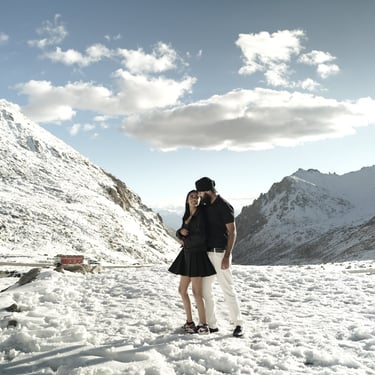
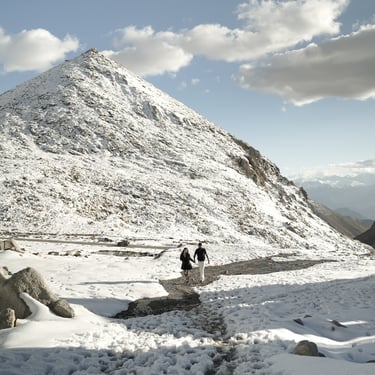
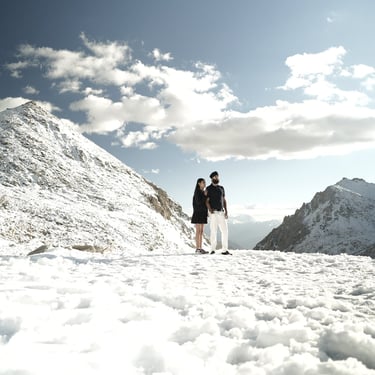
After driving up 17,586 feet, we finally made it to Chang La Pass. The air was razor-thin and crisp, almost stinging with every breath, but what surrounded us was nothing short of surreal. Snow blanketed the jagged peaks in every direction, shimmering under the fierce sun. The sky looked impossibly close—an endless stretch of deep, piercing blue that felt like it could swallow the mountains whole.. Below, the valleys stretched endlessly, carved with winding roads like silver threads weaving through the landscape. It was the kind of beauty that makes you forget how hard the journey was, the kind that silences you without even trying.
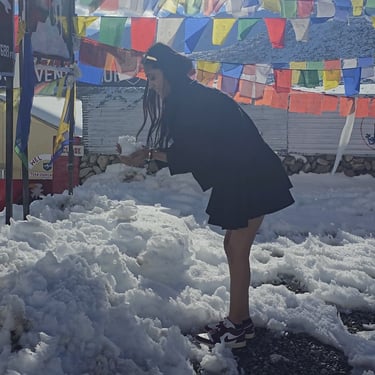
T was freezing. She couldn’t handle the cold, the altitude, or the fact that I—someone who usually despises the cold—was suddenly full of enthusiasm up there. For a brief moment she lit up, scooping up snow in her hands and tossing it into the air, smiling like a child experiencing winter for the first time. But the happiness lasted all of two minutes before the nausea returned. She refused every suggestion we offered—water, food, medication—so I had to roll out my classic “please, just get the shots while we’re here” speech.
It worked. We managed to capture some incredible photos, right up until I decided to take things a little further. Our photographer suggested we play with the snow, but T’s hands were too cold to leave her pockets. Naturally, I took that as an opportunity. I scooped up handfuls of snow and launched them at her—once, twice, three, four times—while she managed to throw back only a single weak shot. And then, unable to resist, I rugby tackled her straight into the snow. Her shriek of pain and fury echoed through the mountains, and though her legs were trembling in the bitter cold, she endured a few more photos before we finally retreated to the car. The descent towards Pangong Lake was far less fun. The road became a cycle of stops, each one for T to lean out and be sick. And this was only the start of what turned into a brutally difficult twelve hours.
The last thirty minutes of that drive to the hotel were pure torture. At some point, T decided it would be a great idea to prop her feet up on the car door and lean her entire body on me. While I was half-asleep, this meant I was slowly being squashed sideways into her friend, who was peacefully snoozing on the other side. By the time I woke properly, both of them were sleeping like happy, innocent babies—while I was stuck in the middle with an aching back, nowhere to rest my head, and the seatbelt buckle pushing into my backside. I internally screamed get me the hell out of this seat. Everyone else in the car was fast asleep too, so it was just me, wide awake, suffering in silence. I finally gave in and asked the driver how much longer it would take. “Twenty minutes,” he said.
He lied.
For the next half-hour, he kept pointing at a distant light and insisting, “Hotel.” It always looked close… until we got closer, and nope—not the hotel. Just another random building glowing in the cold darkness. I could feel my patience draining. Eventually, some of the others began waking up, grumbling with irritation. And then T, still half-asleep, snapped and shouted, “Chup kar yaar!” (“Shut up, man!”) at me. Okay… moody. At least she still had the energy to yell. Just then, one of the cameramen stirred awake and casually said, “Wow guys, look outside at the stars.”
I leaned as far as I could to either side of the window, and I kid you not, I wasn’t prepared for what I saw. The sky was the deepest shade of black, clearer than I’d ever seen in my life, with stars scattered across it like someone had tossed a handful of diamonds onto velvet. They shimmered and sparkled with such sharpness, it almost felt unreal—like I was staring at a planetarium ceiling, except this was the real thing. It was one of those moments you want to soak in fully… but of course, I couldn’t. Between T and her friend pinning me into the seat like a human sandwich, I had about two inches of wiggle room. All I could do was crane my neck awkwardly and admire the night sky in fragments, silently wishing I could step outside for just one uninterrupted look.
We finally reached our hotel around 8 p.m.—pitch dark, bone-numbing cold, and the kind of irritation that only hours of mountain driving can bring. And somehow, things only went downhill from there. The “hotel” turned out to be a row of huts with a small dining area tucked at the end. The moment I stepped out of the car, I wanted to collapse to my knees and scream. The cold. Oh My God, the cold. It wasn’t just freezing—it felt like the air itself was stabbing through my skin, slicing me open with a thousand invisible paper cuts. And no, I’m not being dramatic. I stumbled shivering into our room, only to discover it was somehow even colder inside than it was outside. My jaw clattered uncontrollably, my body shaking like it was trying its absolute hardest to generate its own central heating. T, meanwhile, was buried under layers of sweaters and blankets in her room next door, but even then, she wasn’t warming up—and she certainly wasn’t getting any better.
We all freshened up as best as we could (which basically meant splashing freezing tap water on our faces and questioning all our life choices) before heading into the restaurant for a quick dinner. T, however, wasn’t having it. Altitude sickness had her down bad, and we had to take turns running back and forth to the room, trying—and failing—to convince her to eat. But the real kicker of the night? The “welcome briefing” from the staff. Electricity would cut out at 11 p.m., there was no heating, the electric bed warmers would die halfway through the night, and—just to round off the torture—hot water wouldn’t be available until the next morning. Fair enough… except even something as simple as washing our hands in that icy water felt like willingly dipping them into a glacier. It wasn’t refreshing. It wasn’t invigorating. It was just… sad.