The Hard Road to Pangong’s Beauty
Pangong Lake, Ladakh
Abijit Singh
9/1/20255 min read
The night at Pangong was dark, gloomy, and filled with endless shivering under the blankets. I honestly didn’t know how I was going to drag myself out of bed the next morning, let alone pose in this weather. Until midnight, I was fussing with my suitcase—ironing, tidying, making sure everything was in order. Every few minutes, I’d rush to the sink just to warm my hands under hot water. It took nearly an hour before the pipes finally coughed out some warmth. Meanwhile, T was in the room next door with her mother and friend, fighting her own exhausting battle with high-altitude sickness.
My alarm went off at 4 a.m. We were supposed to be ready by 5 to reach the location for our sunrise shoot at 6. That was the plan—at least on paper. Outside, it was pitch black. The grassy patch just a few feet from my door was barely visible, and beyond that was nothing but a void of darkness. The dogs that had barked all night had finally fallen silent, leaving behind an eerie stillness. But the cold was merciless. Every attempt to move even a single muscle was met with resistance—my jaw clattering uncontrollably as if it had a mind of its own.
I knocked on T’s door. She was lying in bed, unable to move, speak, or even open her eyes without wincing in pain. That’s when I realized—the sunrise shoot we’d planned wasn’t happening. I headed back to my room and braced myself for what I can only call the coldest and hottest shower of my life. Let me explain. The water was hot, but there was no light yet. I had to balance my phone torch on the sink just to brush my teeth and wash my face. Then came the shower—where one side of my body burned under the stream while the other side froze in the open air. Was it enjoyable? Hell no. One second my front side was warming up, my backside was freezing, and vice versa. But with T sick, I knew I couldn’t afford to let myself crumble too. I forced myself through it. The real test came when I turned the water off. The instant the warm stream stopped, the icy air attacked me. My body convulsed, shivering violently from head to toe. Somehow, I managed to get myself dressed, tame my beard, and pull myself together.
When I finally stepped outside, the world had changed. A sliver of sunlight had broken through the darkness, and in front of me was the most unimaginably gorgeous scene. Pangong Lake lay still, its surface the deepest, iciest blue, the kind of blue that chilled you just by looking at it. Behind it, and wrapping around our little huts, were mountains piercing into the sky. Every few minutes, more sunlight kissed the peaks, slowly revealing what felt like a masterpiece of nature being painted in real time. I stood there in awe.
The next hour was a blur of me holding up my phone torch, standing completely still so T’s friend could do her makeup. But her symptoms were only getting worse. We asked the gentleman in the kitchen if there was a doctor nearby. He nodded and woke up our driver, who drove us just two minutes down the road—though even that short ride felt brutal over the rocky path. We knocked on a small house, and a woman opened the door with a child in her arms. After we explained T’s symptoms, she calmly said, “We’ll give her an injection.” T immediately teared up. Things suddenly felt very serious. The doctor appeared from another room, needle in hand, while leaving her child behind. Naturally, the kid started crying. Loudly. At the exact same time, T began crying too. And as both of them grew louder, their voices somehow synced together. I tried so hard not to laugh, but I couldn’t help it—the scene was absurd. There I was, holding T’s face gently, whispering that it was going to be okay, while next to us this kid was wailing like he was in competition with her. When the injection finally went in, T’s tears didn’t stop—but the child’s did. The look on his face was priceless, almost as if he thought: “Bro, you win.” I had to bite my lip not to burst out laughing. We offered to pay for the medicine and injection, but the doctor waved it off, saying it was government funded. So instead, we handed her a little money and told her to buy her kid a chocolate.
Before we left, the doctor decided to check everyone’s oxygen levels just to be safe. T’s mum went first—normal. Then me. I expected the same, but when the little monitor beeped and the number flashed, it read 74, in red. The doctor’s face changed instantly, but I laughed it off, insisting I felt completely fine. No dizziness, slight shortness of breath. She shook her head, clearly not convinced, and firmly told me to increase my water intake right away. I brushed it off at the time, but that eerie number stuck with me.
The crying stopped, all around. We got back to the hotel and ate breakfast whilst T laid in bed. It was 8am now, so the sunrise shot was officially out of the picture. But each time one of us glanced outside, it was impossible not to pause and stare—the view was that hypnotic. Between bites of breakfast, we swapped funny stories, traded bits of life advice, and laughed just enough to forget the chaos of the night before. By 9am, it was time to push forward. After all, the Pangong Lake shoot still awaited us, and once that was over, the long road back to Leh loomed ahead. T gathered every ounce of strength she had to slip into her flowing black flying dress, layering a jacket on top to fight the cold. Slowly, we hauled our suitcases into the car, one by one, each of us dragging our feet but determined. While the photographers and I stood with the driver, he began to explain something that stopped us in our tracks: this place wasn’t just beautiful, it was strategic. A military-controlled zone, bordered by Kashmir nearby and China just beyond the snowy peak glinting in the distance. The thought sent a shiver down my spine—not out of fear, but sheer awe. To be standing here, caught between breathtaking beauty and geopolitical tension, felt surreal. The view before us was more than mesmerizing—it was a reminder of just how layered this place truly was.
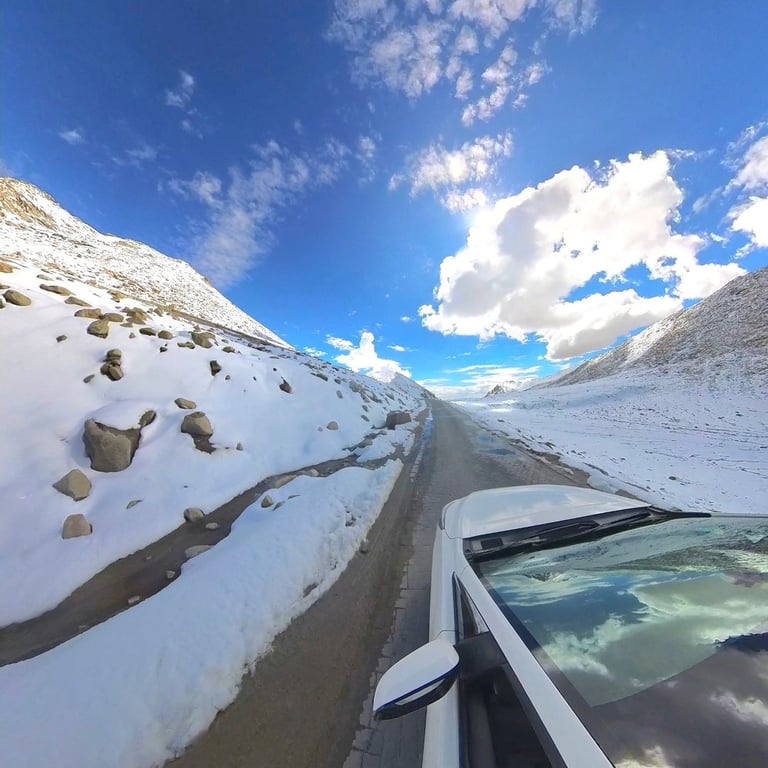
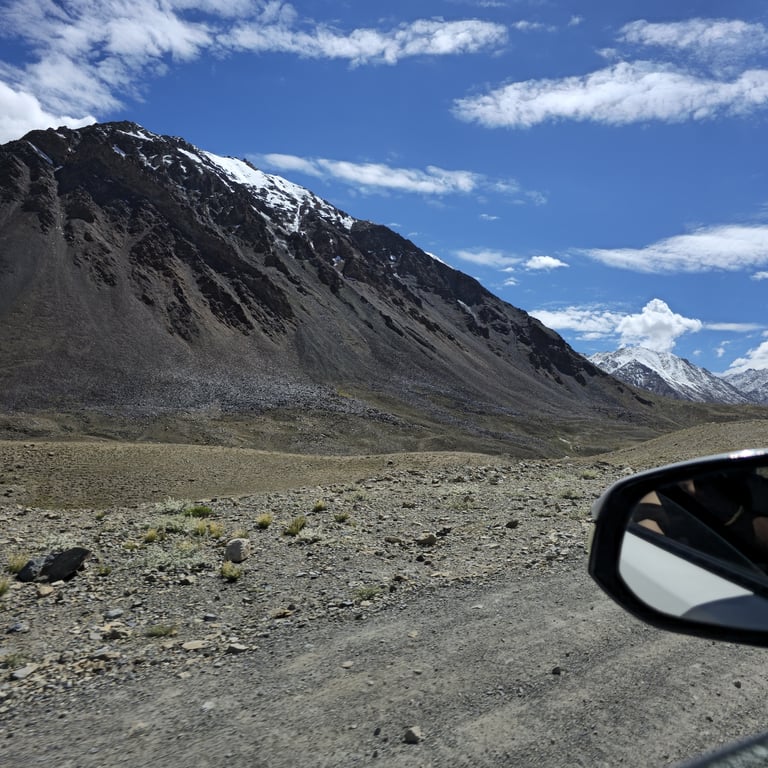
All of us got into the car and headed off to the lake. One last push. It was only about fifteen minutes away, but every second felt heavy. From the back seat, I overheard T quietly whisper to her mother, “I don’t think I can do this.” Her words sat with me the entire ride. Outside the window, the landscape was transforming—vast open skies meeting the calm, icy-blue waters in the distance. Snow-dusted mountains framed the lake like guardians, holding it in place. It was the kind of view that could silence anyone, but inside the car, the air felt tense.