Getting Married: The Moment the World Went Quiet and Two Paths Became One (2)
Delhi, India
Abijit Singh
3/15/20265 min read
I can feel my heart beating. Fast. Everything around me seems to be moving in slow motion. All the attention is on me. My mum talks to me — I listen, process it, then turn to the next relative. And the next. And the next. I can feel my armpits starting to sweat. I decide to sit alone. No food. No water.
Yes… you are still reading the wedding blog, haha.
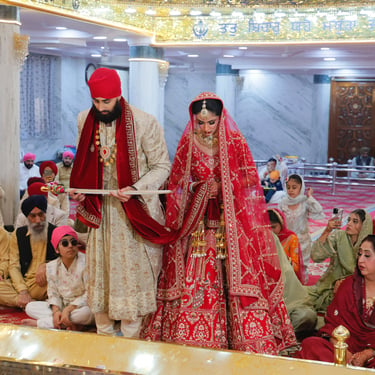
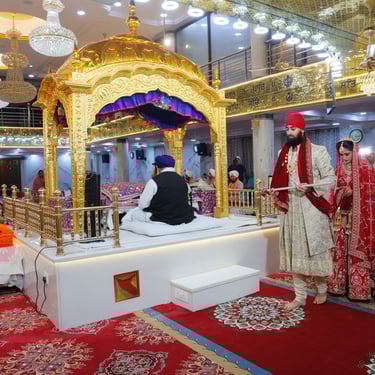
So, let me explain. When it comes to Sikh weddings, the groom’s family meets the bride’s family at the Gurdwara for the Laavan ceremony. This is the main wedding ritual, where the couple walks four times around the Guru Granth Sahib while hymns are sung, each round symbolising a stage of spiritual and marital commitment. By the end of the fourth round, the couple is officially considered married in Sikh tradition.
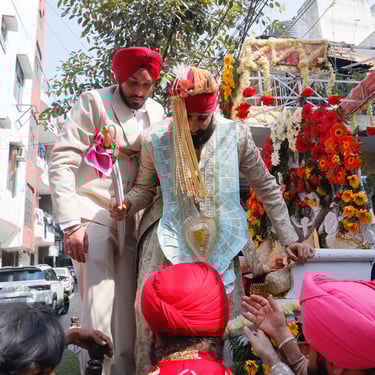
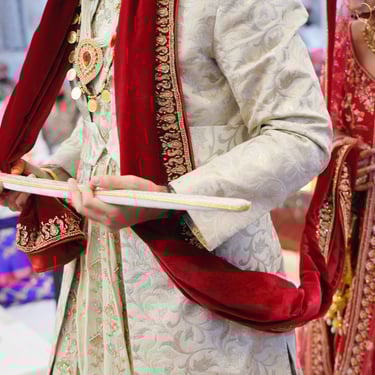
But before that, the groom’s family usually gathers at a banquet hall for breakfast and the Sehra Bandi ceremony, where the groom’s family members tie the sehra — a decorative veil or ornament — onto his turban as a blessing before he leaves for the wedding.
I woke up at 5 a.m., because apparently it’s tradition for the groom to be bathed in either milk or yoghurt. The night before, my cousin mentioned it, but I thought he was just teasing me after seeing my tired eyes and wanting to give me a scare. The real fear came when my mum confirmed it at 2 a.m. So yes — I slept for about two hours. I woke up, had a unique shower , put my pyjamas back on, and just waited. Sleeping again was impossible; my body had completely given up on the idea. My mum left for the beauty parlour while I watched everyone else slowly wake up and take turns getting ready. From that point until I reached the banquet hall for my Sehra Bandi, the anxiety was actually minimal. My only real fear was the one that comes for almost every Sikh groom — and mine had been haunting me years in advance: my legs falling asleep during the Laavan. Oh God. The overthinking.
It reminded me a lot of skydiving. That slight — but not terrifying — fear beforehand. But then, once I hit the one-hour-to-go mark… it really sank in.
And for me, that moment was the Sehra Bandi.
“Eat something.”
“Drink something.”
“Why do you look so sad?”
Those were the three questions on everyone’s mind as they arrived. But I wasn’t sad. I wasn’t hungry either. And I was avoiding liquids because, whenever I’m nervous, my bladder suddenly decides it wants to unleash Niagara Falls.
Logically, no water intake means no water coming out, and since I had not drank anything since morning nothing should come out.
(That logic, of course, failed).
I decided to sit alone in a corner and wait for the rest of the family to arrive. A couple of relatives were taking turns between husband and wife staying at the hospital with their kids, who had caught a mighty stomach bug. Unfortunately, when the time for my Sehra Bandi actually came, my face was basically screaming, “shit, shit, shit, shit.” I looked like I was about to cry.
I wasn’t. I was just annoyed. Firstly, my relatives couldn’t tie the sehra onto my turban properly and almost ended up taking the whole thing off. Secondly, a couple of relatives had already managed to annoy my mum by not listening to her instructions. And the worst thing on your wedding day is having your mother upset. But after all the traditional bits and bobs were done — and after a few dances — we headed outside, where a horse carriage was waiting to take me to the Gurdwara.
The best part of all this was my mum sitting next to me on the horse carriage, getting up every couple of minutes to dance. It was cute and hilarious… but I had a bit of an issue. My “no drinking” rule hadn’t worked. I needed to go to the toilet. Badly. So there I was — stressed, sitting in the sun, a small teddy bear dancing next to me, my face covered, and internally panicking because the whole Laavan legs going numb situation was approaching fast. The Gurdwara was, at most, five minutes away… but my horses were travelling at a speed of roughly two metres per bite of chana (chickpeas). When we finally reached the Gurdwara, I quietly held up my pinky finger to my uncle. He nodded. He understood. I did the same to my dad so he’d know it was serious. Instead of understanding that I needed to, you know… go, he looked at me and asked,
“In your trousers?” Bruh.
I did it. No, not in my trousers. I eventually made it to the toilet, calmed down my bladder — and my mind — and now I was sitting in front of the Guru Granth Sahib, waiting for my wife to make her entrance. My mum was leaning over, whispering in my ear. Fully aware of what I’m like, she kept repeating the same thing:
“Don’t get nervous.”
In the days leading up to the wedding, my family had been regularly reminding me about my walking speed, my posture, and my facial expressions during the Laavan. But it was always my mum who kept saying, “Don’t be scared.”
I tend to get nervous in attention-grabbing situations like this. Suddenly I had flashbacks of a chubby, eight-year-old Abijit standing in the school assembly hall, delivering my very important two-sentence line in front of the whole school — shaking, eyes darting left and right like I was on cocaine — while my mum stood at the back filming it on her camera.
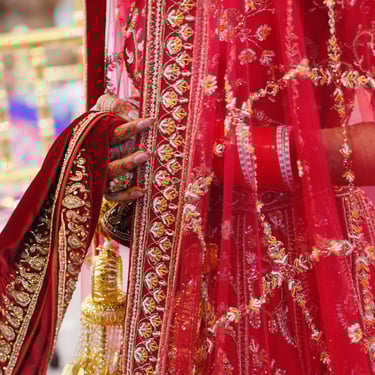
But I was here now. Just minutes away from the Laavan ceremony. I kept pinching my toes, making sure my legs didn’t fall asleep, silently hoping my fiancée would arrive soon. Then, thanks to my excellent peripheral vision, I saw it. A red figure approaching behind me. I turned my head maybe twenty degrees to the left and saw her slowly walking behind me in my direction.. The comfort that came over me the moment I saw her was overwhelming. My eyes suddenly started showing what could only be described as severe hay-fever symptoms. When she finally sat down next to me, my heart rate slowed. Everything went quiet in my head. My arms stopped shaking. My body calmed down. I smiled at her beautiful appearance and told myself: Calm down. You’ve got this. This isn’t a dream — it’s real. It’s a responsibility. That’s the beauty of the Anand Karaj. The ceremony itself mirrors real life. And there’s nobody else in the world you’d rather be sitting here with — guiding, and being guided by — through all of this. She’s scared too. All eyes are on us. Put the anxiety behind you. Waheguru is with you. But more importantly… she’s put all her trust in you.
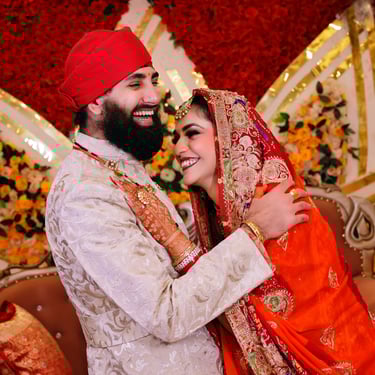
I went on to receive a few compliments. My Laavan went excellently. I was proud. I was officially a husband. The next hour was full of tired eyes from both of us — and extreme hunger. We ate, met a few relatives for pictures, and even managed a little husband–wife gossip, which is apparently far more entertaining than fiancé gossip. But our ability to keep our eyes open was fading rapidly. Both of us had been awake since 4 a.m., running on about two hours of sleep. At that point, all we wanted was to lie down and sleep. But the Doli was still left. The Doli is the emotional farewell ceremony where the bride leaves her parental home and begins her new life with her husband’s family. Traditionally it’s a moment filled with tears, blessings, and a lot of emotional goodbyes as the bride says farewell to her family. And of course… the after-party. Fortunately for me, the heavy weight that had been sitting on my chest — the fear of my legs falling asleep during the Laavan — was finally gone. So I actually enjoyed myself, dancing hopelessly with my family… and my wife.